
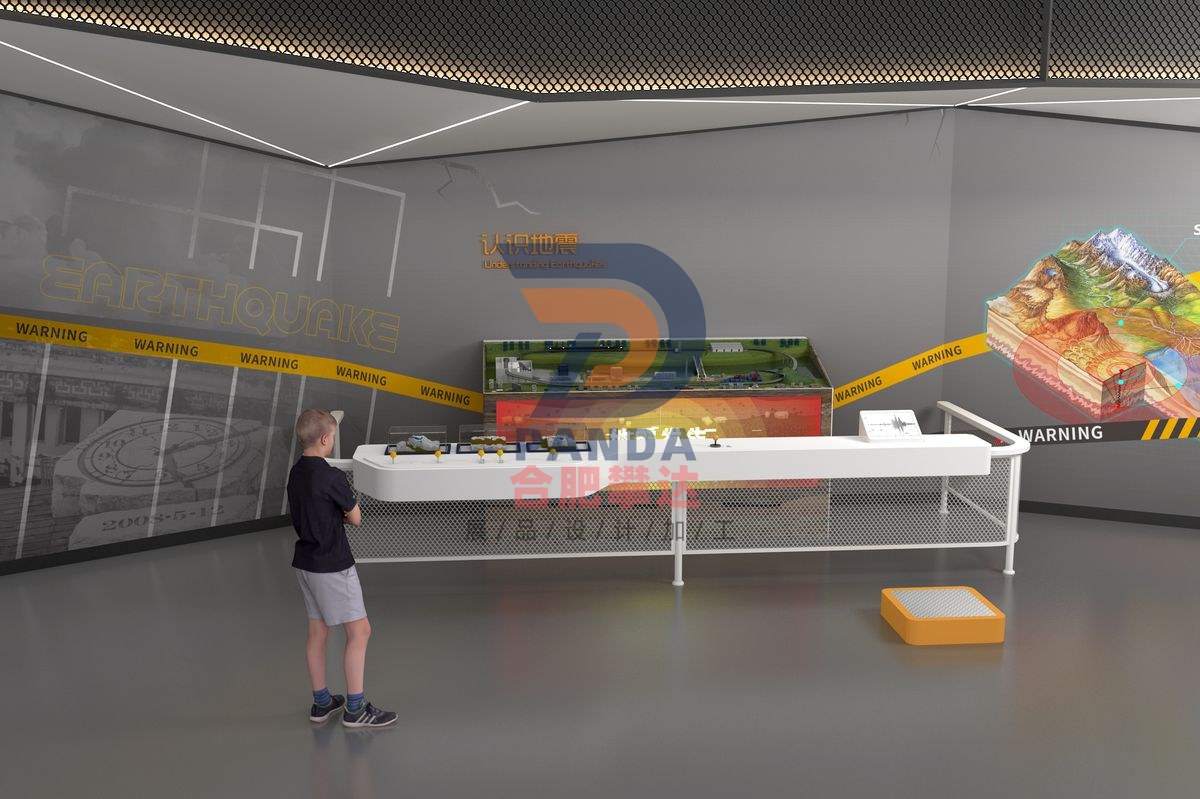
Understanding earthquakes
Safety & Emergency · Interactive
- DimensionsSubject to on-site plan
- PresentationInteractive
- PricingQuoted by manufacture spec
Understanding earthquakes is a hands-on, mechanical & electromechanical interactive exhibit manufactured by Hefei Panda for science centers, children’s museums, discovery centers, STEM learning centers and family entertainment centers. Engineered for durable, robust, low-maintenance, high-traffic gallery installation, it turns abstract scientific concepts into direct, interactive visitor exploration. Hefei Panda is a global exhibit manufacturer exporting hands-on science displays to 50+ countries, with in-house engineering, fabrication, installation and commissioning.
Exhibit Summary
Understanding earthquakes is a Interactive interactive exhibit in the Safety & Emergency category, designed for science centers, children’s museums, discovery centers, STEM learning centers and family entertainment centers. Built as a hands-on, mechanical & electromechanical display, it turns an abstract scientific concept into direct, interactive visitor exploration, and is engineered for durable, low-maintenance, high-traffic gallery use.
Scientific Principle
Through hands-on experiences, the causes of earthquakes and the meanings of terms related to earthquakes are displayed, allowing the audience to have a preliminary understanding of earthquakes.
Operation
This exhibition item is an exhibition group, and the multimedia interaction includes two sub-exhibitions: earthquake source magnitude and intensity, and measuring earthquakes. Earthquake source magnitude and intensity: It consists of a console, a splicing screen and a miniature sand table model. Set three cursor interaction points on the screen, corresponding to different focal depths and magnitudes. The audience makes selections via the hands-on unit and watches the corresponding demonstration animation to grasp the relationship between earthquake source magnitude and intensity. Measuring earthquakes: It consists of a booth, a ground stepping unit and a seismic waveform recorder model. Guests step or jump on the ground hands-on unit and watch the waveform curve on the recorder. Earthquake source magnitude and intensity: Displays include operation desks, splicing screens and miniature sand table models. The front is inlaid with a splicing screen, which displays the earth's crust. Above the screen is a miniature sand table of the earth's surface. There are some movable unit models on the sand table, such as trees, telephone poles, electricity towers, etc. In front of the entire unit is an operating console. The audience can select the magnitude via the buttons and the depth of the earthquake focus via the slider. After starting, the screen will display the occurrence of the earthquake and the seismic waves will spread to the surroundings. Model devices at different distances from the epicenter produce different vibration amplitudes, allowing the audience to grasp the relationship between intensity and magnitude, focal depth and epicenter distance. Measuring earthquakes: Set up an hands-on unit, including a booth, a ground stepping unit and a seismic waveform recorder model. The audience steps or jumps on the ground hands-on unit to watch the waveform curve on the recorder. The graphic content introduces the earthquake magnitude standards and measurement methods currently used in China, and introduces the calculation formula of earthquake magnitude, possible negative magnitudes and other interesting earthquake knowledge, thereby attracting the audience's participation. Plate movement: Set up an hands-on unit, including a booth, a storage box, three types of customized sponges (representing discrete, convergent and conserved plate boundaries respectively) and an extrusion unit. There are stripes on the side of the sponge to represent the crustal strata. The audience takes out the customized sponge from the storage box, puts it into the extrusion unit, turns the handle, watches the wrinkles caused by the stripes on the side of the sponge after being extruded, and grasps the impact of plate movement on plate boundaries.
Export-Ready Features
- Durable, robust construction for high-traffic gallery environments
- Low-maintenance electromechanical design with reliable, safe components
- Custom sizing, theming & multilingual labeling available
- OEM & turnkey exhibit solutions with full project management
- Overseas shipping, export documentation & on-site installation supported
- Shipped to science centers and museums in 50+ countries