
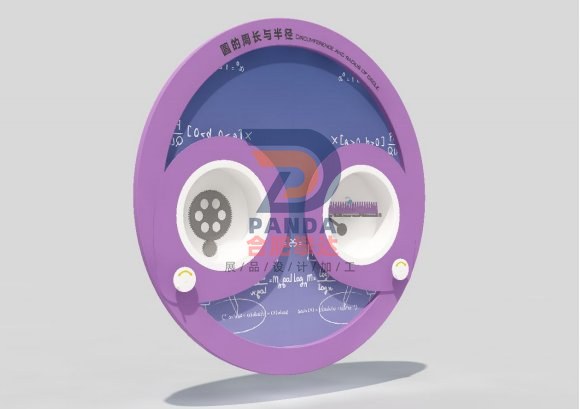
Experiment on the relationship between the radius and circumference of a circle
Mathematics · Interactive
- Dimensions⌀0.95×0.85
- PresentationInteractive
- PricingQuoted by manufacture spec
Experiment on the relationship between the radius and circumference of a circle is a hands-on, mechanical & electromechanical interactive exhibit manufactured by Hefei Panda for science centers, children’s museums, discovery centers, STEM learning centers and family entertainment centers. Engineered for durable, robust, low-maintenance, high-traffic gallery installation, it turns abstract scientific concepts into direct, interactive visitor exploration. Hefei Panda is a global exhibit manufacturer exporting hands-on science displays to 50+ countries, with in-house engineering, fabrication, installation and commissioning.
Exhibit Summary
Experiment on the relationship between the radius and circumference of a circle is a Interactive interactive exhibit in the Mathematics category, designed for science centers, children’s museums, discovery centers, STEM learning centers and family entertainment centers. Built as a hands-on, mechanical & electromechanical display, it turns an abstract scientific concept into direct, interactive visitor exploration, and is engineered for durable, low-maintenance, high-traffic gallery use.
Scientific Principle
After measurement, it can be found that the circumference of a circle is always between the two. The more sides a polygon has, the closer it is to the circumference of a circle. In ancient times, the problem of circles almost relied on induction from experiments. People have found in experience that there is a constant ratio between the circumference and diameter of a circle, and this constant is called pi (noted as and in the West). Later mathematicians tried to figure out the specific value of this and. The mathematician Liu Hui used the method of "circle cutting", that is, using the circumference of the inscribed regular polygon and the circumscribed regular polygon of the circle to approximate the circumference of the circle. The circle was found to be close to a 192-sided shape, so the pi ratio was about 3.14. The circumference of a circle refers to the mathematical phenomenon in which a regular n-sided polygon is inscribed in a circle. The side length is set to an, and the circumference of the regular polygon is n×an. As n continues to increase, the circumference of the square continues to approach the circumference C of the circle. That is, n approaches infinity, and C=n×an.
Operation
Use a rope to measure the circumference of a circumscribed regular polygon, a circle, and an inscribed regular polygon. You can find that the circumference of a circle is always between the two. The more sides a polygon has, the closer it is to the circumference of a circle.
Export-Ready Features
- Durable, robust construction for high-traffic gallery environments
- Low-maintenance electromechanical design with reliable, safe components
- Custom sizing, theming & multilingual labeling available
- OEM & turnkey exhibit solutions with full project management
- Overseas shipping, export documentation & on-site installation supported
- Shipped to science centers and museums in 50+ countries