
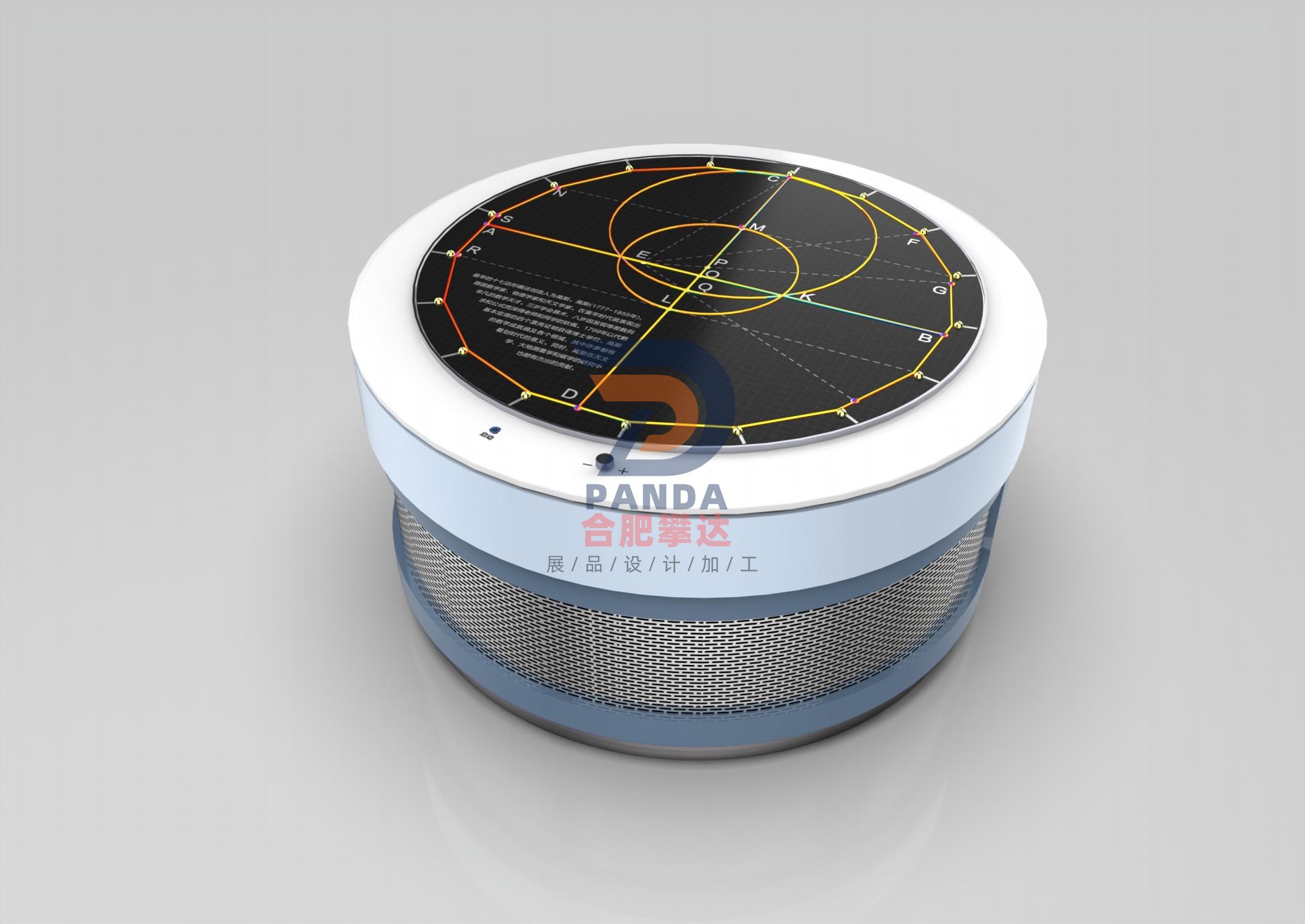
Seventeen equal parts of a circle
Mathematics · Electromechanical Demonstration
- DimensionsDiameter 1500*800mm
- PresentationElectromechanical Demonstration
- PricingQuoted by manufacture spec
Seventeen equal parts of a circle is a hands-on, mechanical & electromechanical interactive exhibit manufactured by Hefei Panda for science centers, children’s museums, discovery centers, STEM learning centers and family entertainment centers. Engineered for durable, robust, low-maintenance, high-traffic gallery installation, it turns abstract scientific concepts into direct, interactive visitor exploration. Hefei Panda is a global exhibit manufacturer exporting hands-on science displays to 50+ countries, with in-house engineering, fabrication, installation and commissioning.
Exhibit Summary
Seventeen equal parts of a circle is a Electromechanical Demonstration interactive exhibit in the Mathematics category, designed for science centers, children’s museums, discovery centers, STEM learning centers and family entertainment centers. Built as a hands-on, mechanical & electromechanical display, it turns an abstract scientific concept into direct, interactive visitor exploration, and is engineered for durable, low-maintenance, high-traffic gallery use.
Scientific Principle
Step 1: Given a circle O, make two perpendicular radii OA and OB. Make point C on OB to make OC=1/4OB. Make point D on OA to make ∠OCD=1/4∠OCA. (First use the property that the base height of an isosceles triangle is also an angle bisector to make 1/2, and then make 1/2 of 1/2 in the same way.) Make point E on the extension line of AO so that ∠DCE=45 degrees. (First draw the perpendicular line of DC passing via point C, make 90°, and then make 45°) Step 2: Draw the midpoint M of AE, and draw a circle with M as the center that passes via point A. This circle intersects OB at point F. Then, with D as the center, draw a circle that passes via point F. This circle intersects the straight line OA at two points G4 and G6. Step 3: Make a vertical line OA via G4 and intersect circle O at P4, and make a vertical line OA via G6 and intersect circle O at P6. Then use circle O as the base circle, A is not the first vertex of the regular heptadagon, P4 is the fourth vertex, and P6 is the sixth vertex. Connect P4P6, take 1/2 arc P4P6 as the radius (the midpoint of P4P6 is Q, connect OQ, and extend the intersection circle O of OQ to S; use the chord P4S or P6S as the radius, not half the chord p4p6), and continue to intercept on the circle. You can intercept all the vertices of the regular heptagon on this circle.
Operation
A set of electromechanical hands-on devices is designed for the exhibition. Through flowing lights, it reveals the audience in an intuitive way how seventeen equal parts of a circle are made. The countertop of the booth is covered with a layer of transparent plexiglass, and small light strips are embedded in the table. The light strips are controlled by a program system. During the path of the light strips lighting up and extinguishing, they eventually appear as seventeen equal parts of the circle. Electromechanical demonstration Press the buttons in sequence and watch the drawing process of 17 equal parts of the circle.
Export-Ready Features
- Durable, robust construction for high-traffic gallery environments
- Low-maintenance electromechanical design with reliable, safe components
- Custom sizing, theming & multilingual labeling available
- OEM & turnkey exhibit solutions with full project management
- Overseas shipping, export documentation & on-site installation supported
- Shipped to science centers and museums in 50+ countries