
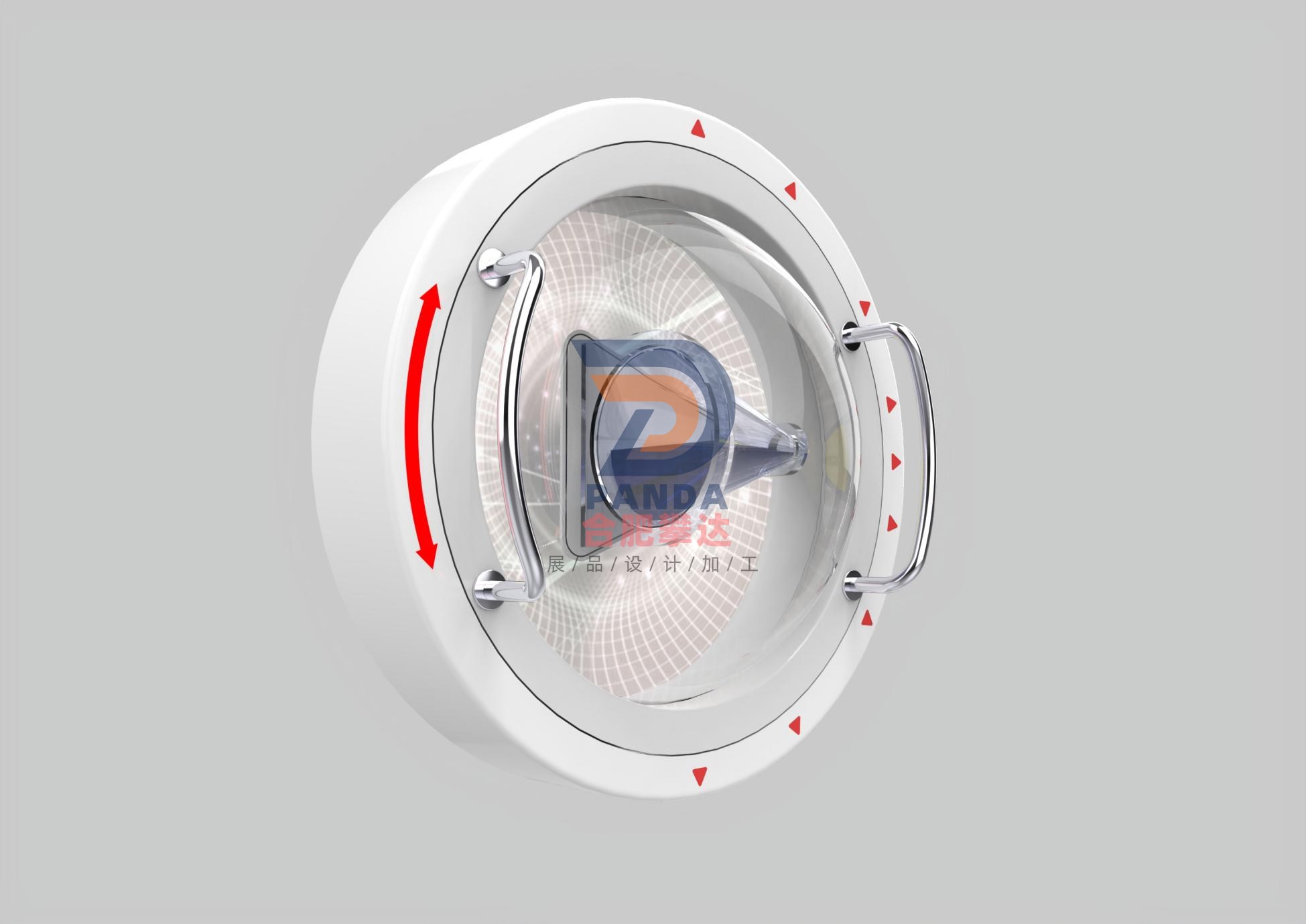
Conic Sections
Mathematics · Mechanical Interaction
- DimensionsDiameter 900*370mm
- PresentationMechanical Interaction
- PricingQuoted by manufacture spec
Conic Sections is a hands-on, mechanical & electromechanical interactive exhibit manufactured by Hefei Panda for science centers, children’s museums, discovery centers, STEM learning centers and family entertainment centers. Engineered for durable, robust, low-maintenance, high-traffic gallery installation, it turns abstract scientific concepts into direct, interactive visitor exploration. Hefei Panda is a global exhibit manufacturer exporting hands-on science displays to 50+ countries, with in-house engineering, fabrication, installation and commissioning.
Exhibit Summary
Conic Sections is a Mechanical Interaction interactive exhibit in the Mathematics category, designed for science centers, children’s museums, discovery centers, STEM learning centers and family entertainment centers. Built as a hands-on, mechanical & electromechanical display, it turns an abstract scientific concept into direct, interactive visitor exploration, and is engineered for durable, low-maintenance, high-traffic gallery use.
Scientific Principle
The ancient Greek mathematician Apollonius used the method of cutting a cone with a plane to study these types of curves. If you truncate the cone with a plane perpendicular to the axis of the cone, you will get a circle; if you gradually tilt the plane, you will get an ellipse; when the plane is tilted to be parallel to a generatrix of the cone, you will get a parabola; when the plane is tilted further, you will get a hyperbola. Apollonius once called the ellipse the "loss curve", the hyperbola the "hypercurve", and the parabola the "uniform curve"
Operation
The exhibition consists of a conical container filled with liquid and a curved scale plate. The conical container is fixed on a disk and has a transparent hemispherical cover. When the audience turns the circular handle on the disk, the curve formed by the liquid surface also changes. When the conical container containing liquid is rotated so that the tip of the cone is aligned with the scale on the scale plate, the arrow will indicate which type of cone it is, and the cross-sectional shape of the liquid surface in the cone will be observed. 1. Rotate the circular handle on the disk so that the tip of the conical container is aligned with the scale on the scale plate; 2. Watch the cross-sectional shape of the liquid surface in the cone.
Export-Ready Features
- Durable, robust construction for high-traffic gallery environments
- Low-maintenance electromechanical design with reliable, safe components
- Custom sizing, theming & multilingual labeling available
- OEM & turnkey exhibit solutions with full project management
- Overseas shipping, export documentation & on-site installation supported
- Shipped to science centers and museums in 50+ countries